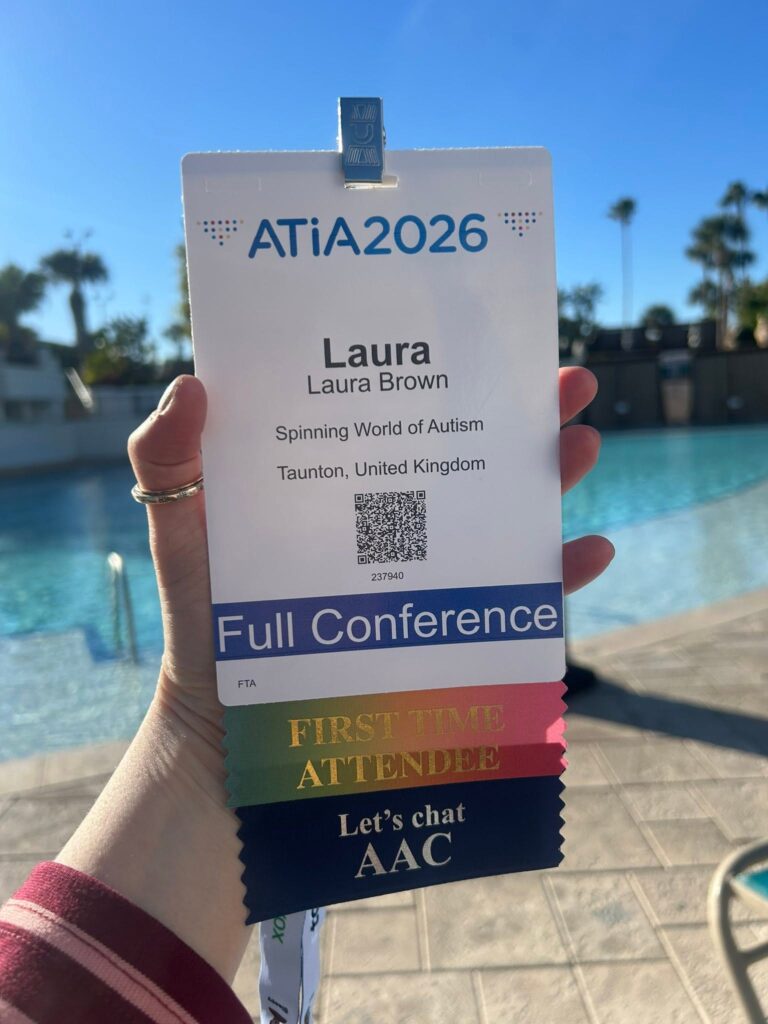
Flying out to Florida to attend ATIA 2026, with my conference buddy Kate Reader, has been one
of the absolute highlights of my advocacy work so far & something I will truly remember forever.
I’m Laura, parent of a non-speaking autistic child who uses an AAC device first & foremost, but
secondly, I’m an exceptionally proud Autism & AAC advocate. Ethan, who has used his AAC
device for over two years, is the light of our world & his AAC use has changed all of our lives for
the better. He gives us insights into his world, he can tell us when he needs help or when he’s
poorly & we can see his incredible sense of humour.
As the parent of an AAC user, rather than a strict professional in the world of Assistive
Technology, I was a little apprehensive to apply for the AT Scholar opportunity. But, inspired by
previous Scholar’s & my own little boy’s use of AAC I decided to take the plunge.
Cue Tina’s call, another memory that will stay with me forever, sharing the news that I had been
chosen to attend ATIA in person & as they say the rest is history.
Here’s a few things I picked up from the conference that have informed my AAC
advocacy work & use within my own home ever since:
- A reminder that communication is hard to do, especially for autistic AAC users, when
overstimulated. But, there are a few things we can do to make communication as easy
as possible during tough periods. – i.e use settings to turn down screen-brightness, tone
down colours, create specific easy-to-use regulation folders or filters. Could you even
record your own softer parent-voice specifically for this folder?
- The need to be incredibly careful that we don’t unintentionally teach performance or
compliance for AAC users; we don’t want to create a world where they say what they
think we want to hear, rather than what’s important to them. AAC users need an
“importance of belonging” the device needs to be theirs & they must be shown how to
access language such as “no”, “go away”, “I don’t want to” etc & it be respected. A quote
that stuck with me – “If an AAC users feels like they are not listened to, they will just stop
communicating”
- AAC users need to see themselves as communicators & for this to happen authentic
communication needs to be accessible & age appropriate. True humour, true protesting,
true wants & needs = true communication. We shouldn’t decide what the AAC users’
opinions, authentic thoughts & humour is – we need to get rid of any taboo/censorship &
have authentic communication at the heart of everything we do.
- From “Taboo or not Taboo” – “Abuse thrives when communication is censored” – not nice
to consider, but that’s exactly why we need to.
- AI, whilst needing to be used carefully & ethically, is something that can definitely
support AAC use. One wonderful idea I came across was using AI chat to support using
AAC in play. For example, you could describe the age of your child, their favourite TV
show, what you are playing with & ask AI to share some key phrases from the show you
could input into their AAC device. Play creates fun AAC use & builds skills such as turn
taking, imagination, listening, interaction – all with fun at its core. I loved this as although
we didn’t yet have folders purely for play based on TV shows, we have had lots of lovely
AAC moments with my son communicating phrases from his favourite TV shows
throughout the day – I know how hugely motivating this is for him from lived experience.
- The importance of social interaction opportunities with peers who also use AAC to
communicate. This should be led by AAC users & not directed by professionals –
“professionals should refer to us” – love this!
- Modelling communication around perceived requests. I.e if the AAC users say
“chocolate” don’t automatically assume they want chocolate – could they want to talk
about chocolate instead. Model “I love Chocolate”, “It’s my favourite”, “It’s so crunchy” so
you’re also demonstrating talk around the subject.
- AAC users report over & over again how AAC improves their quality of life in every way
including within education, respect, social relationships etc. And caregivers also report
less worry, deeper relationships with their children & real connection.
And, last but not least, I hugely enjoyed the Prentke AAC distinguished lecture from the one &
only Mateo Moreno – here’s 4 takeaways, but I had many many more!
- Students often understand my AAC device way more than teachers. Teachers test,
students converse. Teachers seem to naturally have low expectations when peers seem
to be the opposite – they often wait to really listen.
- Why is there often a double standard for AAC users? We must listen to AAC users & all
the ways they communicate. Please never say “use your device” when they have used
Makaton perfectly to communicate.
- “Not being able to speak, didn’t stop me from wanting to be heard.”
- The importance of AAC mentorship & community. It takes time to learn how to
communicate with other AAC users but the benefits are huge for everyone.
Thank you to everyone who makes this ATIA opportunity happen – being part of the Assistive
Technology community is an incredible place to be & a true privilege.
Good luck to all AT Scholars in 2027 & beyond.